Showing posts with label Guaitil. Show all posts

Sunday, September 5, 2010

Chorotega pottery in museum in San Vicente

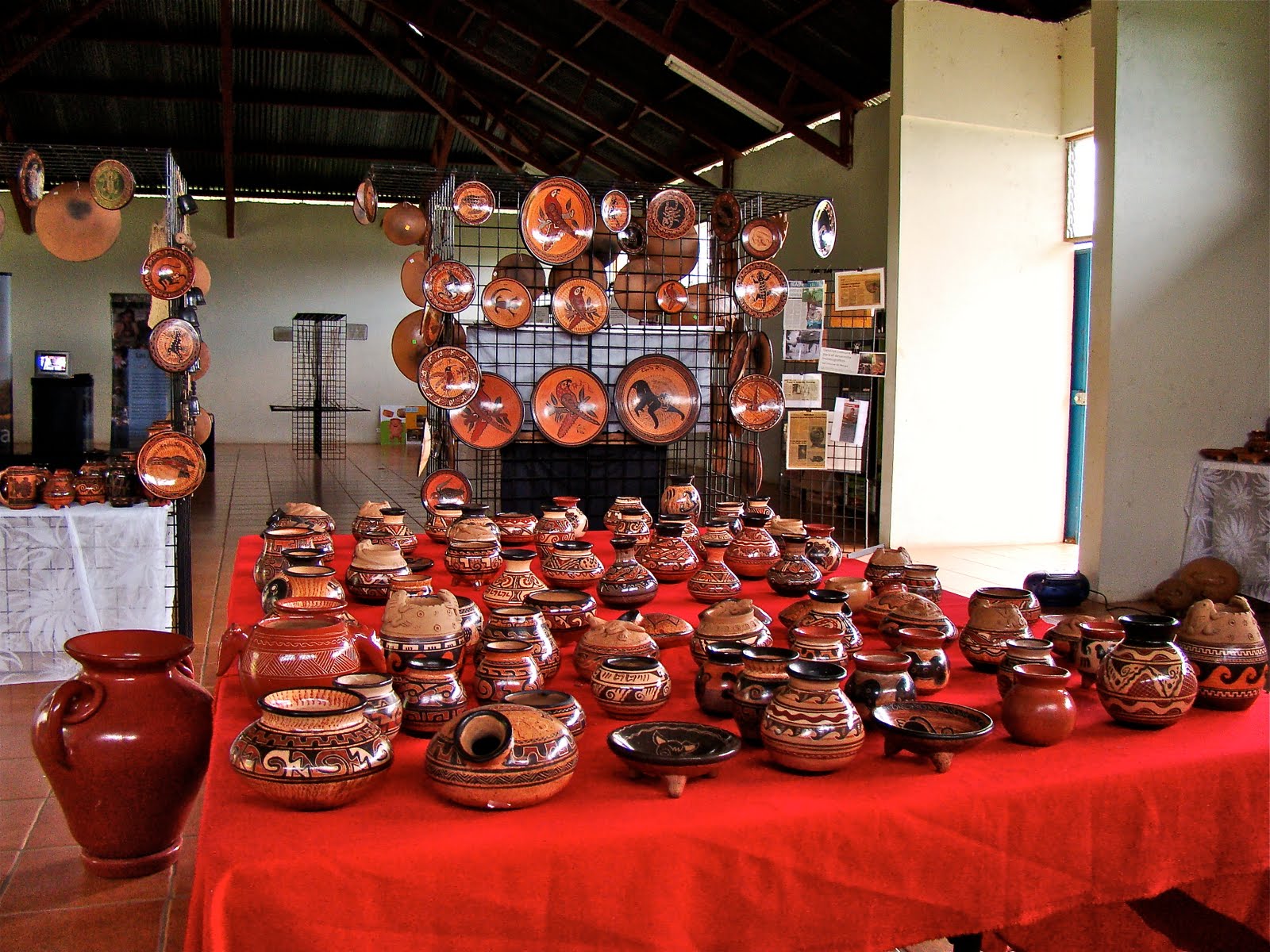
This photo shows the beauty and artistry of Chrotega Pottery. Some artisans make reproductions of pre-Columbian designs. Others have modified the styles to appeal to the tastes of tourists.

The clay and locally available materials feature earth tones, as you can see in this photo. The designs use both geometric and animal motifs.

This is the last photo in my series on Chorotega pottery and the Ecomuseuo de la Ceramica Chorotega in the village of San Vicente. It is a great place to buy pottery. It is a convenient stop after taking a wildlife river trip in Palo Verde National Park. Here is a link to the website for the ceramics museum.

Today is Sunday, so we have new photos on our Viva la Voyage travel photo site. This week we are showing photos of the birds, bridge and bats of Sydney, Australia.

Saturday, September 4, 2010

Ceramics oven at museum

This is a closer view of the oven shown in the photo yesterday. The artisans build a wood fire inside the oven to bake the pottery. With the local clay and a wood burning oven, the ceramics are not as strong as the modern ceramics and china that is fired in a high temperature kiln.

Here is a link to the website for the Ecomuseo de la Cermica Chorotega.

This week we are showing photos of a remote area of Aututaki in the Cook Islands of the South Pacific on our Viva la Voyage travel photo site.

Friday, September 3, 2010

Ceramics museum garden and oven

This is the garden area and oven behind the the Ecomuseuo de la Ceramica Chorotega. They have demonstrations showing how they make the pottery, and they also grow traditional herbs. Here is a link to the website for the ceramics museum.

San Vicente is a very small village, and I think it is great that they have a museum to display the traditions, and to help offer a market for the work fo the artisans. The museum opened in 2006. It is affiliated with the Museo Nacional de Costa Rica.

Many of the guide books will mention the pottery village of Guaitil a mile or so away, but they do not always include the smaller village of San Vicente or this fairly new ceramics museum.

This week we are showing photos of a remote area of Aututaki in the Cook Islands of the South Pacific on our Viva la Voyage travel photo site.

Thursday, September 2, 2010

Chorotega pottery in museum in San Vicente

This photo shows a display of Chorotega pottery in the Ecomuseo de la Ceramica Chorotega in San Vicente. Costa Rica does not have a lot of pre-Columbian art because the native population was almost wiped out by the Spanish during colonial times.

Chorotega pottery is a pre-Columbian tradition that survives in the villages of San Vicente and Guaitil. It is possible to buy the pottery directly from the artisans. It is also possible to buy this pottery in shops in Tamarindo and other tourist areas. In Tamarindo, there are even street vendors who will walk the beach and offer pottery, although fortunately they are polite and not aggressive like vendors in some countries.

Yesterday Sharon of Phoenix Daily Photo asked if we bought much pottery at the museum. I bought more than 20 items. We will use them for gifts for the colleagues who work for us in our office in Arizona. I hope none of them will read this post, as now it won't be a surprise.

Here is a link to the website for the ceramics museum.

This week we are showing photos of a remote area of Aututaki in the Cook Islands of the South Pacific on our Viva la Voyage travel photo site.

Wednesday, September 1, 2010

Pottery Market and Museum

Today's first-day-of-the Month worldwide Daily Photo Theme is open air markets. I am bending the rules a little bit, as this market is partly open air and partly under a roof, but I want to share with you a delightful museum and market.

This is the market area of the Ecomuseo de la Ceramica Chorotega, located in the town of San Vicente, a little down the road from the pottery village of Guaitil. It is like an open air market, as they display the pottery of local artisans around a large room that also has museum displays, with a garden and oven for making pottery out back. Many of the pottery artisans in San Vicente and Guaitil sell pottery in open air market areas in the front of their homes where they make their pottery.

These are the women who work in the museum and pottery market. They obviously are friendly, enjoy their work, and are proud that they are helping to carry on the pre-Columbian traditions of Chotoga pottery. I will show more of it during the next few days. Here is a link to the website for the museum.

This week we are showing photos of a remote area of Aututaki in the Cook Islands of the South Pacific on our Viva la Voyage travel photo site.

To see how other Daily Photo bloggers have interpreted today's theme of open air markets, Click here to view thumbnails for all participants

Thursday, September 3, 2009

Guaitil Pottery Bowl with Butterfly

This is another example of Chorotega pottery made in Guaitil, Costa Rica, about a half hour inland, or east, from Tamarindo.

This is a more contemporary design, made to appeal to tourist tastes, rather than the more traditional design that I showed yesterday. The pattern around the border of this bowl looks traditional, but I doubt that in pre-Columbian times the indigenous people of Costa Rica made pottery with butterflies against a swirling background, and I am positive that they did not write expressions such as "Pura Vida" on their pottery.

Pura Vida is the national slogan of Costa Rica. It is Spanish, of course, for "pure life." Costa Ricans, who are also called "Ticos"use "pura vida" in ways similar to "aloha" in Hawaii. It can mean hello, good bye, all is well, I'm fine, or just about any other friendly greeting. It sums up the national attitude that helped make Costa Rica ranked number one as the happiest nation on earth, according to a major study by a foundation in London.

Wednesday, September 2, 2009

Guaitil Chorotega Pottery Bowl

Here is a sample of Chorotega pottery from Guaitil. You will notice the earth tones and the reddish color from the red clay in the riverbank used for making the pottery. The artisans today continue to use pre-Columbian motifs in the decoration of the pottery.

The name Chorotega comes from a Choltec word that translates as the people who fled. The name results from the migration of the ancestors of the Chorotega native Americans who fled conflicts in their homeland in Mexico to resettle in Costa Rica about 800 A.D.

I did not mean to confuse you by the desert plants in the background of this photo. This photo was taken in Phoenix, not Costa Rica, as we have tropical, not desert, plants in Costa Rica. I took this photo at the house of a friend to whom I had rented our condo in Tamarindo, and when we sent to her house for a party she showed me some of the pottery she purchased in Costa Rica, which I photographed to post on this website. I will have another example tomorrow.

Monday, August 31, 2009

Chorotega Guaitil pottery

This Guaitil artisan is painting a vase. The workshops where the pottery is made are open air, with the pottery being shaped, being fired in traditional wood burning adobe ovens, and being painted in plain view of tourists who walk from shop to shop.

A visit to Guaitil is often combined with a wildlife boat trip of Palo Verde National Park. Tour operators who pick up tourists in Tamarindo to take them on a wildlife boat trip will usually stop for a traditional lunch in a nearby village, and then stop in Guaitil on the drive back to Tamarindo.

The popularity of Chorotega pottery has led to a rekindling of cultural awareness and pride in pre-Columbian culture among people in Guaitil and nearby villages.

There is surprisingly little pre-Columbian culture in Costa Rica. Tragically, the indigenous population of Costa Rica was nearly eliminated after Spanish settlement of the area. The introduction of diseases from Europe for which the local population did not have immunity was a major cause. But another cause was the enslavement of Costa Ricans to use them to work the mines in Peru and Mexico. Costa Rica was not a rich area (contrary to its name, which means "rich coast"). The Spanish used some of the local population to supply badly needed labor to work the mines elsewhere. The devastation of the indigenous population was so extensive that it has been estimated that despite large immigration, it was not until the 1930's that the population of Costa Rica recovered to reach the same number than lived in the country when Columbus arrived on his fourth voyage.

The vast majority of Costa Ricans ethnically are white, of European descent, because the indigenous population was almost totally wiped out. Estimates are that of the present population of 4 million, only 150,000 Costa Ricans are indigenous. The Guanacaste region of northwest Costa Rica, where Tamarindo is located, is the part of the country that has the greatest surviving remnants of indigenous heritage, although it is not prevalent.
Sunday, August 30, 2009

Guaitil Chorotega Pottery

Guaitil pottery, also called Chorotega pottery, is popular in Costa Rica. It is one of the few artistic traditions that survive from pre-Columbian times in Costa Rica. Chorotega is the name of the pottery, and Guaitil is the village where it is made.

Guaitil is a pottery village about a half hour inland from Tamarindo. Around the town square, which like many mall towns in Costa Rica is a football or soccer field, there are a dozen or so workshops of artisans who make and sell the pottery. There are about 100 families who have formed cooperatives to make and sell pottery. Some of them combine their workshop and store with their house. People can walk from shop to shop and admire the goods, but also watch the pottery being made.

This artisan is shaping a pot. Most Chorotega pottery is shaped into pots, bowls, plates or animals. Often a short stub of a three-legged tripod is attached to the bottom of plates to make them stand up off the shelf or table. The pottery is painted in earth tones.

Chorotega pottery may be purchased in shops in Tamarindo or elsewhere in Costa Rica, although buying directly from the artisans and watching the pottery being made in Guaitil is more fun and interesting. Some guidebooks have said called the Chorotega pottery in Guaitil as the most authentic aspect of pre-Columbian culture that remains in Costa Rica. I will explain the reasons for that tomorrow. Don't worry, I will also show some finished Chorotega pottery as well in the days ahead.

Today is Sunday, so my wife and I have posted a new series of photos on our Viva la Voyage travel site. Last Sunday we showed some photos from an old seaside village on the outskirts of Casablanca, so this week we showing some photos of people in modern Casablanca.

Thursday, July 17, 2008

Cattle drive through town

On a visit to the pottery village of Guaitil, which was the subject of my June 23 photo, you can imagine my surprise in seeing cattle being driven through the middle of town. Two boys were rounding their herd back to a corral for the night after a day in the pasture.

This quaint practice did yield to technology, as the two boys performed their cattle round up duties on a bicycle and a small motorcycle. The cattle made a right turn at the town square, where they should have gone straight through the intersection, presumably after obeying the stop sign. This photo was taken right after the boys had sped around in front of the herd and got them turned around and heading back to the square, where they made a right turn for a block, then a left, and on back to their corral.

The Guanacaste province of northwest Costa Rica has a tradition of cattle ranching, but usually the cattle are on haciendas or fincas, not in the middle of town.

Tuesday, July 8, 2008

Pottery making in Guaitil

This man is making pottery in Guaitil, carrying on a tradition that dates back before the arrival of Columbus. The oven used to bake pottery is visible behind him.

On June 23 I posted a photo of the church in Guaitil, and several people posted comments asking me to show the pottery. I decided to show the pottery making process first, beginning with today's photo, that shows the shaping of a vase.

In a few days, I will show a photo of a man painting the pottery, and a few days after that I will show what the finished pottery looks like.

Monday, June 23, 2008

Church in Guaitil

This is the church in Guaitil, a small village. In the foreground is part of the football (soccer) field, which is in the main square of typical Costa Rican villages.

Guatiil is an artists village, with about 100 families making pottery in the same style and techniques as the Chorotega pre-Columbian culture. The artists' families welcome visitors to watch them as they shape the pottery, fire the pottery in dome shaped outdoor ovens, and paint the pottery.

Guaitil is located just east of Santa Cruz, which is about 30 minutes southeast of Tamarindo. It is a popular stop for tourist vans on the way back to Tamaindo after wildlife viewing boat excursions in the area. I will post additional photos about Guaitil and its pottery in the future.
Related Posts Plugin for WordPress, Blogger...