Saturday, November 28, 2009

Hummingbird and his wings

I like this hummingbird photo because the camera was fast enough and the hummer's wings were slowing down to land, so that the wings were partially captured in the photo.

I have mentioned the exceptionally high metabolism of hummingbirds, their lack of storage capacity for calories, and their very frequent feeding. That raises a question. What do they do at night? How do they store enough calories to keep their little hearts beating so fast?

The answer is that at night they lower their body temperatures as much as 17 to 28 degrees C. (30 to 50 degrees F.) and go into a very deep sleep to conserve energy. Like bears in the winter up north, in essence they hibernate each night!

Hummingbird feathers were of special importance to the Aztecs, who used them in wedding ornaments.

25 species of hummingbirds are considered threatened. One of those, the mangrove hummingbird, is found only in the mangrove forest patches of Costa Rica's Pacific coast, such as the Tamarindo and Langosta estuaries that I have shown on the past on this website. It is critical to protect such habitats.

This week we are showing nighttime photos of Budapest on Viva la Voyage. Budapest is beautiful at night, even if it does not have any hibernating hummingbirds.

Friday, November 27, 2009

Hummingbird's back

Hummingbirds are classified according to their color, and their colors are often irridescent. They are native to the Americas. I wonder if they have spread to Europe, Asia, Africa or Australia.

I selected this photo because it is unusual to see the back of a hummingbird. In flight, the usual view of a hummingbird is a profile, not his back, because by the time you could see his back, he would be gone. Hummingbird's are naturally curious, and they will dart around people to check them out, then dart off when their curiosity is satisfied. They can hover in place and can even fly backwards, which makes them unique.

This appears to be a female green-crowned brilliant hummingbird, known locally as brillante frentiverde, and its scientific name is heliodox jacula.

This week we are showing nighttime photos of Budapest on Viva la Voyage.

Thursday, November 26, 2009

Hummingbirds at the feeder

Today is the Thanksgiving holiday in the USA, where most of the readers of this blog are located. Rather than showing a large turkey, I am showing tiny hummingbirds this week. Hummingbirds need to feed often because of their high metabolism. They move fast, their hearts beat 10 times faster than ours, and they store so few calories that they weigh about the same as a large paper clip.

These two birds are likely not a pair. Male hummingbirds mate with females, but otherwise are not involved with the females, who nest and raise the children alone.

Hummingbirds can be territorial and scare off other birds, including other hummingbirds, from the flowers they frequent. In this shot the birds are sharing the feeder nicely, and evidently must share the nectar with a bee.

This week we are showing nighttime photos of Budapest on Viva la Voyage.

Wednesday, November 25, 2009

Hummingbird

Costa Rica has more than 50 species of hummingbirds. They must eat several times per day to support their hyper-active metabolism, which includes a heart rate that beats 600 - 1,000 times per minute. They get all of their food through nectar from flowers or, such as this photo, from a hummingbird feeder.

Hummingbirds are difficult to photograph because they move so quickly. The feeder makes it easier, as it provides a spot on which to focus and provides a place where you know hummingbirds will come. Photographing a hummingbird in flight in a garden or forest is extraordinarily difficult for me.

This week we are showing nighttime photos of Budapest on Viva la Voyage.

Tuesday, November 24, 2009

Female Golden-browed Chlorophonia

Most restaurants in Costa Rica are open air, like the restaurant that I showed yesterday. In one restaurant that we went to in Monteverde, a small injured bird was found and was being nursed back to health by the workers in the restaurant. Here is the bird, sitting in a milk carton that the restaurant staff used to hold the bird.

This looks like a female golden-browed chlorophonia, which is a member of the tanager family. A male golden-browed chlorophonia differs from because it has a yellow streak on his forehead and over his eye, and his coloration is a little brighter.

Tanagers are native to the Western Hemisphere. There are 230 different species of tanagers. They will flock with other birds and will inhabit areas close to man. They particularly like fruit trees.

Costa Rica is home to more species of birds than the USA and Canada combined, so I feel fortunate when I can find a bird with which I was not familiar in a guidebook in order to share the information for this website. I confess that I was not familiar with the name of golden-browed chlorophonias until I looked up this bird photo.

This week we are showing nighttime photos of Budapest on Viva la Voyage.

Monday, November 23, 2009

Beach at the Barcelo Resort

This is the beach at the Barcelo Langosta Resort, which I showed yesterday. The Pacific Ocean is to the right, and the mouth of the Langosta Estuary is in the center of this photo. Across the mouth of the estuary you can walk for miles along Langosta Beach. This beach is very popular with surfers. One person who stayed in our Langosta Beach condo described it as "epic surfing."

Our condo is about 50 meters behind the spot where this photo was taken. We do not surf, but we love to go for walks along the beach.

Saddle up to the bar

If someone wants to "saddle up to the bar," what better way than to sit on a real saddle and to look out at a forest while listening to the rushing water of a river?

This is a roadside cafe on the way from San Jose to Monteverde. It was the morning when we stopped by, so it was too early for customers to be lounging on the patio and the outdoor bar overlooking a river and forest. This struck me as a unique setting for a restaurant, but if there every was a place where a bar with saddle seats positioned to overlook a river and forest seems in place, Costa Rica would be it.

This week we are showing nighttime photos of Budapest on Viva la Voyage.

Sunday, November 22, 2009

Pinuela

Pinuelas plants are relatives of the pineapple, as is apparent from this photo of the fruit. The fruit is edible, but it is sour.

They grown in the wild, and are planted in places as a natural barrier. The leaves are thick, sharp blades more than one meter long, with thorns on the edges of the leaves. No one could walk through a thicket of pinuelas plants, as they would slice up your legs and tear your clothes.

Our condo on the beach in Playa Langosta has a barrier of pinuelas plants on the back of the building to separate the building from the beach. The dense thicket of spikes and leaves keeps people from the beach from wandering up to the pool area, as we certainly would not want strangers in the pool. The plants are a little less than one meter (3 ft.) tall, allowing views of the ocean over the plants.
It is a more attractive barrier than a fence.

Today is Sunday, so we have posted new photos on Viva la Voyage.
This week we are featuring night-time photos of Budapest, Hungary.

Saturday, November 21, 2009

Heliconia

Here is yet another heliconia. This variety is a heliconia wagneriana. I mentioned yesterday that some heliconia flowers, such as yesterday's, hang down and some others, such as today's photo, grow upwards.

This type of heliconia grows 2 - 4 meters tall (6 - 13 ft.) , and is native to an area from Belize and Guatamala south through Costa Rica to Ecuador.

Friday, November 20, 2009

Heliconia

This is a heliconia rostrata, known locally as a platanilla. Some heliconias have flowers that hang down, while others have flowers that grow up. This plant's flowers hang down.

Heliconias are widely planted in gardens in Costa Rica. They are popular in part because their flowers bloom all year round. We have heliconias in the gardens around our condos in Tamarindo, although this is another of the photos that I took in the Lankester Botanical Garden near San Jose.

Check out photos of Murano, Italy at Viva la Voyage!

Thursday, November 19, 2009

Flower at Lankester Gardens

Here is another flower of the thousands of species of plants growing at the Lenkester Botanical Garden. I am sorry that I do not know the type of flower that is shown in this photo. Perhaps a reader will know and will leave a comment educating me.

Wednesday, November 18, 2009

Orchids

This is a sample of just a few more of the 800 species of orchids in the Lankester Botanical Garden near San Jose.

The garden feature a trail that allows an easy walk through areas that feature bromeliads, heliconias, palms, bamboo, cacti and succulents, and more.

For visitors to Costa Rica who begin their trip in San Jose, the gardens are a nice way to get oriented to the different types of plant species in Costa Rica so that visitors will recognize and appreciate the plants that they will see in the wild for the remainder of their trip.

By the way, speaking of visitors, I should mention that an article in one of the Costa Rica newspapers recently said that although tourism is down a little bit due to the worldwide recession, it is not down very much in Costa Rica compared with other places. In 2008, there were more than 2 million foreign visitors to Costa Rica, which is very good for a country with a little more than 4 million people. Think about what the visitor traffic would be like in your country if the number of visitors over the course of a year equalled one-half of the number of residents.

Tuesday, November 17, 2009

Orchid

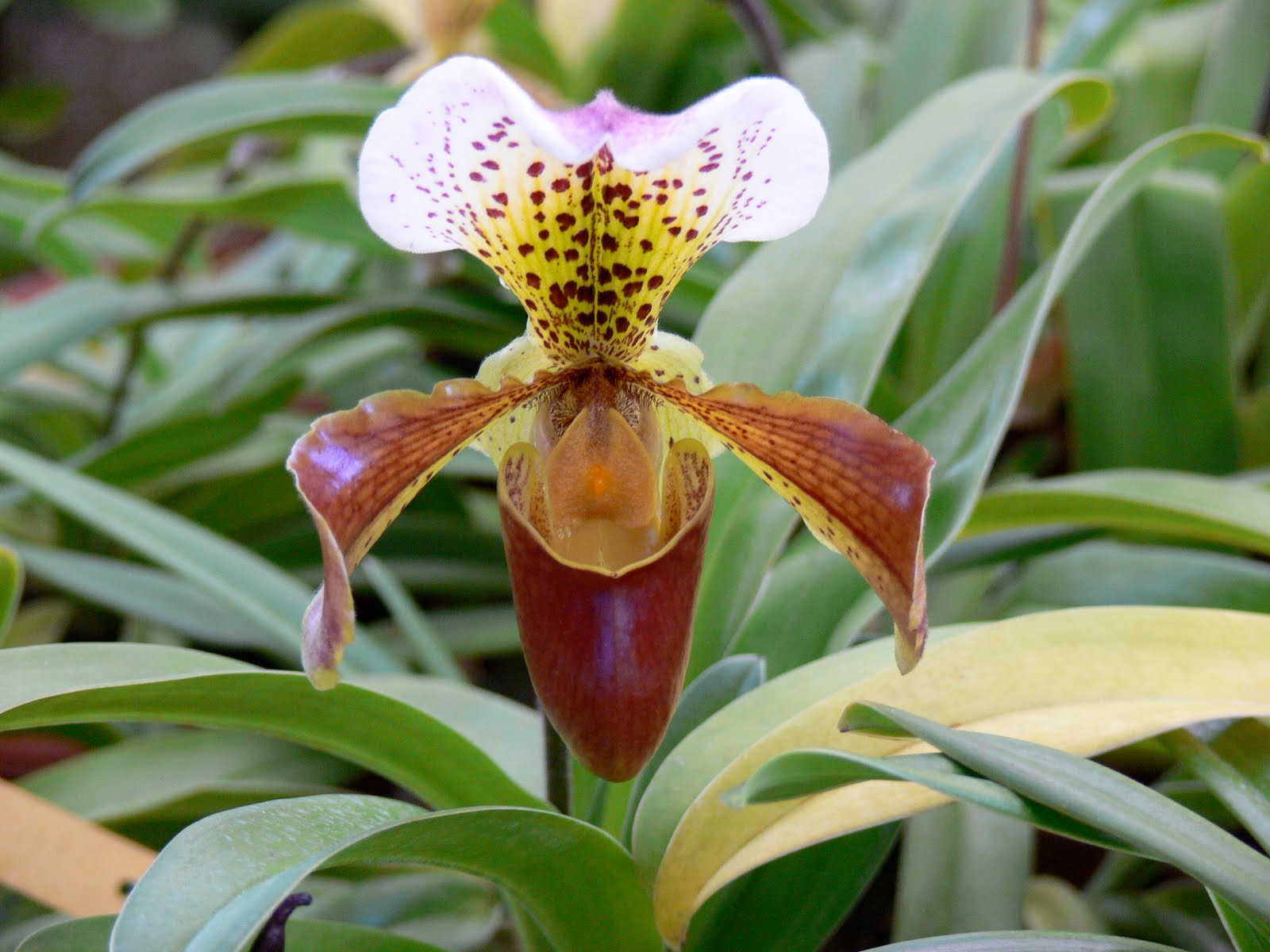
I have not posted flowers in quite some time, so here is an orchid. 1,500 species of native orchids grow in the wild in Costa Rica, and you can see them on hikes in the forest.

The easiest way to admire orchids, of course, is in gardens where varieties are displayed in plain view, without having to go on a hike in the forest for an occasional specimen. I took this photo in Lankester Botanical Gardens near San Jose. It cultivates more than 800 varieties of orchids, and more than 3,000 different plant species.

Lankester Gardens was founded in 1973 to carry on the work of a British amateur orchidologist, Charles Lankester, who planted an extensive garden of orchids and epiphytes on his farm. When he passed away, the American Orchid Society and the Stanley Smith Horticultural Trust recognized the importance of preserving his garden and took the lead in donating the 11-hectares (28 acres) garden to the University of Costa Rica, which maintains it for public visits.

Monday, November 16, 2009

Sunset

This is a closer view of the same sunset as yesterday. As the sun descends closer to the ocean, the marine layer of clouds start to give a marble texture to the color of the sun.

Sunday, November 15, 2009

Sunset

It has been quite a while since I showed a sunset photo. Here is another sunset over the Pacific Ocean shown from the balcony of our condo on the beach in the Playa Langosta area of Tamarindo.

Today is Sunday, so we have again posted new photos on our Viva la Voyage travel photo site. This week, we are following up last week's photos from Venice by showing photos from Murano, Italy, one of the islands in the Venetian lagoon, famous for its centuries-old tradition of glass blowing.

Saturday, November 14, 2009

Dog retrieving stick

Here is a closer photo of yesterday's dog. The enthusiasm and joy of the dog is evident in the splash of the water as the dog runs back to shore to return the stick to his master.

I have a soft spot for Yellow Labrador retrievers, as this dog appears to be. While my two boys were growing up we had a Yellow Lab named Tortilla, as she was the color of a flour tortilla..

Friday, November 13, 2009

Dog playing on the beach

Some dogs have trained their masters quite well to throw sticks for the dogs to retrieve. What better place to play and retrieve sticks than the beach? If either the dog or master get hot, there is the refreshing Pacific Ocean to splash around in to cool off.

I don't know who was having more fun, the dog or his master.

Thursday, November 12, 2009

Playing ball on the beach

This appears to be a father and son paying ball on Tamarindo beach. They were having as much fun as the dogs playing in the surf behind them.

The beach appeared to be a good place to kick the ball around. The beach was like an automatic ball return. If they kicked it to the right, the slope of the beach would bring the ball back down. If they kicked the ball too far to the left, the waves would bring the ball back up.

And if they got hot and sweaty playing ball, well, there's the refreshing Pacific Ocean for a dip to cool down.

Wednesday, November 11, 2009

Surfer celebrating

An instant after the photo I showed yesterday this surfer struck this pose. His clenched fist pump looks to be a gesture similar to Tiger Woods when Tiger sinks a long or crucial putt. I will certainly not diminish his sense of satisfaction with his surfing accomplishments. It looks to me like he has reason to celebrate.

Tuesday, November 10, 2009

Surfer riding the crest of a wave

This surfer is riding the crest of a wave. He is extending his arms either to help his balance or to draw attention to his exciting form and adventuresome approach to surfing.

Tomorrow I will show you what happened to him next. Do you think he fell down and wiped out, or do you think he continued to ride this wave, surfing with a flourish?
Related Posts Plugin for WordPress, Blogger...