Thursday, October 23, 2008

Nibbana Restaurant


This is the Nibbana Restaurant, which is located on the beach in the center of Tamarindo. Beyond the covered portion of the restaurant shown here is an area of tables under palm trees, and the ocean is just beyond those tables. The entrance to the restaurant, visible from the main street of Tamarindo, is shown in the second photo.

The restaurant has a website that features its menu and many photos of its meals and drinks. The menu features seafood, pasta, and other dishes. Nibbana is one of the many fine restaurants in Tamarindo that we enjoy.

Wednesday, October 22, 2008

Michael Landon's house


This triangular shaped house, visible from a distance in yesterday's photo, was owned by the late Michael Landon, according to the guide who accompanied us on a tour of the Central Valley. Michael Landon, of course, was the star of the Bonanza, Little House on the Prairie and Highway to Heaven TV series.

Michael Landon died in 1991 at the age of 54 of pancreatic cancer. Despite that early passing, he was on U.S. network TV series for 28 years, which is an accomplishment few actors have achieved. He was also frequently the TV host for the Tournament of Roses Parade in Pasadena, California on New Year's Day each year.

The fact that U.S. TV and movie stars have found retreats in Costa Rica speaks well of the country. As I mentioned in an earlier post, it recently became known that Mel Gibson has a house a little south of Tamarindo. The local papers in Costa Rica carried photos of Britney Spears on the beach with her family while they were vacationing using Mel Gibson's house.

Tuesday, October 21, 2008

Orosi Valley


This is a view of one of the valleys in the central part of Costa Rica, not far from the capital of San Jose. The central valleys are popular both for tourists and for retirees from the U.S., who are attracted to the ideal year-round weather, lower cost of living, and availability of health care and other services.

There is something special about this valley, however. Tomorrow I will feature a photo of the unusual, triangular-shaped house located in the lower center of this photo (which you can detect only if you click and enlarge the photo). For viewers of old TV series, I'll give you a bonanza of a hint of whose house it used to be: it is obviously not a little house on the prairie.

Monday, October 20, 2008

Orchid


Costa Rica is home to many varieties of orchids. They can be seen in the wild, in planted gardens around hotels and condos, and in botanical gardens. I have a chart that shows different types of Costa Rican orchids, but this one is not on the chart, so I regret that I cannot comment on the type of orchid this is. I guess this shows that I can enjoy the diverse colors, shapes, structures and scents of flowers even if I am relatively ignorant about them.

Sunday, October 19, 2008

Heron


This is another heron, although I apologize that unlike yesterday's photo, I do not know what type of heron this is.

The heron family, which is called Ardeidae, consists of herons, egrets, and wading birds called bitterns. 15 of the 58 species in the heron family are found in Costa Rica.
The mythical phoenix bird, that dies, is burned and rises again from the ashes is regarded to be a heron. Egyptian hieroglyphics for the phoenix legend show what appears to be a heron or egret.

Saturday, October 18, 2008

Little blue heron

This is a little blue heron, locally called a garceta azul in Spanish. It reaches 66 cm. (26 in.) in height, with a wingspan of 1 meter (39 in.). They live in lowland aquatic regions along Costa Rica's Pacific and Caribbean coasts. This heron has found a nice perch above a river and is ready to move into position to stalk and strike at is prey

The juvenile little blue herons are white in color with a dark or greyish bill. The scientific name for the species is egretta caerulea. This is a relative of the
bare-throated tiger egret that I posted on July 16. Tomorrow I will post another egret for comparison.

Friday, October 17, 2008

Dragonfly Bar and Grill


This is the entrance to the Dragonfly Bar and Grill. Like most restaurants in Tamarindo, it is open air, with a roof, but no walls on the front and both sides.

The second photo shows the interior. (Please excuse the blurriness, but I took the photo at night without a flash, as I did not want to bother the patrons or the waitress by flashing a photo in the middle of their meal.)

Dragonfly has a website that includes its menu and photos of its meals. Its entrees include creative meals such as Fiery Thai beef over glass noodles & herbs with chile-lime vinaigrette and chopped peanuts; Filet mignon over charred onion & roasted garlic mashed potatoes, french beans & stone ground mustard sauce; Chipotle & green onion glazed crispy chicken breast over sweet corn cake & fresh avocado, and Pan roasted Mahi-Mahi over sweet corn and orzo salad with a cilantro pesto.

As I have mentioned before, my wife is very serious about fine dining, and the presence of excellent restaurants in Tamarindo was crucial to our decision to buy a condo (actually, two condos) in town. We decided to buy condos right in town rather than at one of the destination resorts outside of town because we want to be able to walk to a variety of excellent restaurants.

Dragonfly is located just a short walk from the main intersection in Tamarindo. It is one of our favorite restaurants in town.

Thursday, October 16, 2008

Prayers for healing


People come to the spring alongside the Basilica of Our Lady of the Angels to pray for healing of ailments and injuries. Many of them will leave behind a token or medallion, called a milagro, of the body part or organ that is injured or diseased. The church has displayed the milagros of body parts in glass cases in the basement of the church near the spring that I showed in yesterday's photo. This is a photo of one section of one of the cases.

The church displays manny of the milagros grouped together, so there might be an entire case of legs, or hearts, etc. I chose this photo because it displayed the greatest diversity of different types of organs or body parts. You will notice the milagros of those praying for help for their legs, feet, eyes, lungs, hands, spine, and more. (I apologize for the reflection in the glass covering the case, but it was unavoidable.)

I don't know about you, but this makes me wonder about the lives of each of the people who left these milagros. How are they and their families doing now?

Wednesday, October 15, 2008


This is the shrine at the site of the spring next to the Basilica of Our Lady of the Angels, which I have shown in my posts during the last several days. Visitors walk on the circular ramp shown in this photo. The spring itself feeds water to an area in the shadows of this photo. People will fill containers with the spring water to take home.
The waters of this spring are considered to have the power to cure diseases, injuries or disabilities. Tomorrow I will show what is left behind by people who come to the spring to seek healing.

Tuesday, October 14, 2008

La Negrita Statue in Basilica


My post the day before yesterday told the story of the peasant girl who found a small figure of a dark skinned Virgin Mary that twice mysteriously returned to the site of its discovery in 1635. The figure is preserved in a case that is high above the altar, surrounded by gold and jewels. The figure is visible in the center of this photo. I realize the quality of the image is not great, but I had to take this photo from a great distance using natural light, as the figure is very high above the altar.

This is the most important church and holy site in the Costa Rica. The church is named Basilica de Nuestra Senora de Los Angeles, or Our Lady of the Angels. The statue is called La Negrita. On August 2 each year, the anniversary of the discovery of the statue in 1635, La Negrita is paraded though the streets of Cartago. Thousands walk the 24 km. (15 miles) from San Jose to Cartago, some carrying crosses or walking part of the way on their knees, which is another similarity to the Basilica for the Virgin of Guadalupe in Mexico City, where people also make pilgrimages at times on their knees.

I don't know about you, but the impression that I receive is that the simplicity of the La Negrita statue is rather overshadowed by the ornateness of the gold and jewelry of the case in which La Negrita is displayed. The case does, however, certainly communicate that this is something important and cherished.

The gold rays that surround the area where La Negrita is encased are another parallel to the Virgin of Guadalupe in Mexico, which has rays that surround a much larger image of the Virgin.

Monday, October 13, 2008

A dog-on-the-beach story

Here is a sequence of photos of a dog on the beach near our condo on Playa Langosta. I love the freedom and enthusiasm for the ocean shown by children and dogs. This dog stopped to dig furiously with a focused concentration.


Just as quickly as the dog started digging furiously, the dog was distracted by the arrival of BIG DOG, and the two romped off to play together with just as much enthusiasm as the dog had been digging.

The owners of both dogs were nearby, receiving the vicarious pleasure of sharing the enjoyment of their dogs for the beach and ocean.

Sunday, October 12, 2008

Basilica facade


This is the front facade of the Cathedral of Our Lady of the Angels in Cartago, near San Jose. I posted a photo of the angel on the top of the church the day before yesterday. The site on which this church was built is considered holy for two reasons, the first is the story I will tell below, and the second is a spring with waters that people consider to have the power to cure diseases.
In 1635, an indigenous peasant girl named Juana Pereira found a small dark skinned Virgin Mary on a rock. Twice the virgin was removed and twice it miraculously returned to the rock where it was found. A church was built built on the site of the rock in 1635. The virgin is preserved in a case above the altar, which I will show in my post on the day after tomorrow.
Does the above story sound familiar? Anyone who has been to Mexico City will find parallels to the story of the Virgin of Guadalupe, whose image appeared to a peasant on a cloth in 1531 and is preserved in a basilica built at the spot of the revelation, which is now the second most visited Roman Catholic shrine in the world.
The church in the photo above was built in 1929, replacing an earlier church that was destroyed in an earthquake in 1926. The stone facade was built in a Byzantine style, with Moorish arches.

Saturday, October 11, 2008

Purple flowers


This is another of the flowers at our condo building in Langosta. My book on Costa Rican plants tells me that this is a stachytarpheta jamaicensis, which is the most common of the two native species of stachytarphetas in Costa Rica. There are three non-native similar species also growing in the country.
This shrub is up to 1.5 meters (4 ft.) tall, which makes it well suited to grow as a colorful border around the sidewalk and parking area of our condo building (which is barely visible in the background of this photo.)

Friday, October 10, 2008

Angels


This is the angel on the top of the Cathedral of our Lady of the Angels in Cartago, not far from San Jose. This is Costa Rica's most sacred site and most important church. There has been a church on this spot since 1635, although the current church was built in 1929 after the previous church was destroyed in an earthquake. I will show more photos of the church in the future.

I am showing the angel today as a theme to introduce three photos of the angel flute on some champagne glasses that I was asked to show by some readers of Monte Carlo Daily Photo, as the glasses were the subject of a story that I told in comments on that site yesterday. Here is a link to that site, where you can read the story in the comments to the October 9 post.

I have tried to show in the photos how the glasses capture light and how the head and wings of the angel seem to glow. When there is champagne in the glasses, the glow of the angels acquire a hue the color of the champagne.

Thursday, October 9, 2008

"Poor man's umbrella" leaf detail

Yesterday's photo of the lake in the crater of Irazu Volcano showed a poor man's umbrella plant in the foreground. Here is a close-up of one of the leaves. The leaves are large, often about 75 cm. (2 ft.) across. They are strong and could keep smaller plants or animals dry from the rain. I will show another photo of plants with huge leaves in a couple of days.

Wednesday, October 8, 2008

Irazu volcano crater and lake

This is a closer view peering down into the lake inside one of the five craters of Irazu Volcano. The plant growing in the foreground is called a "poor man's umbrella," as its leaves are huge. In contrast to the lush vegetation in most of Costa Rica, only a few species of plants grow in the moonscape of the high volcanic craters.

There are many fumaroles in the national park, frequent emissions of clouds of steam, and frequent seismic activity at this active volcano.

Tuesday, October 7, 2008

Irazu volcano crater

This is a closer photo of the lake in the crater of Irazu volcano, which I showed yesterday. The lake is yellowish green in color because of the sulfuric content of the water.

The crater is 1,050 meters (3,444 ft.) in diameter and 300 meters (984 ft.) deep. That makes it the largest crater in Costa Rica. Bring a jacket if you plan to visit, as it is cool at the high elevation, otherwise you will be scurrying back to your car if it becomes windy.

The crater is a short walk from a parking area, so this is a convenient volcano to visit. There are hiking trails to the four other craters in the park.

Monday, October 6, 2008

Irazu volcano

This is a view of the one of the five craters in Parque Nacional Volcan Irazu (Irazu Volcano National Park), located in the central valley not far from the capital of San Jose. On clear days, it is possible to see across the entire country, from the Atlantic to the Pacific, from the summit, with is 3,430 meters (11,260 ft.).

Irazu gets its name from an Indian word, irstaru which appropriately means "mountain of thunder." There is a legend that an Indian chief sacrificed his daughter to the volcano gods, then later prayed to the gods for assistance in battling a neighboring tribe. The volcano gods answered his prayer by erupting, raining fire on the other tribe, and causing a mud slide to wipe out their village.

The volcano is active, although its last famous eruption occurred when U.S. President John F. Kennedy was in Costa Rica for a meeting of the Organization of American States in March 1963. I will show some closer photos of the crater during the days ahead.

Sunday, October 5, 2008

Butterfly on lantana flower


Costa Rica has 1,250 different species of butterflies. Here is a butterfly flapping its wings on a lantana flower. Butterflies usually rest with their wings closed, or at times pause with their wings all the way open. I selected this photo because it caught the wings in motion, showing the color on both sides and the body of the butterfly.
Lantana grow from the American Southwest through to Brazil, although they have also been introduced in south Asia, the Pacific islands and Africa.
Butterflies polinate lantana plants. Hummingbirds also visit lantana for nectar. Lantana bloom all year round. The bushes reach a mazimum of about 1 meter (3 ft.) in height, and are widely used to add color to the border of walkways and driveways. The lantana shrubs were I stopped to catch this photo of a butterfly was along the sidewalk in front of our Langosta beach condo.

Saturday, October 4, 2008

Pablo's garden

This is Pablo, the gardener at our condo on the beach in the Langosta section of Tamarindo. He takes pride in his work. I was taking some pictures of some of the butterflies and flowers at our building recently, and Pablo came up to show me and point out several of the flowers. When I asked to take his photo, he brushed back the leaves to make sure that a flower was visible in the photo as well.

This flower is a heliconia, which popular in Costa Rica. There are a variety of types of heliconia, some with flowers that grow upward, as this one does, and some with flowers that hang down.

The scientific name of this variety is heliconia latispathia, also called platanilla or wild plantain. It is the most common type of heliconia in Costa Rica. It reaches from 2 to 6 meters (6 to 19 ft.) in height. The plant grows like a banana plant. Its flowers bloom all year long. It produces a fleshy seed, which provides food for birds, during September through November.

Pablo is a wonderful gardener. He keeps the plants and flowers in lush conditions out front along the sidewalk, all around the parking area, and around the patio and pool area out back by the beach. He helps look after things at our 21-unit condo building, supplementing the security guards who are on duty 24/7.
Pablo speaks English well. When I told him that I do this daily photo website and planned to post his photo on the site, I asked him if he had a computer with Internet access. He answered, "Of course." I hope he enjoys his photo being posted on this website a fraction of the amount that we and the guests who rent our condo enjoy his flowers. I will show more photos of his flowers during the coming days and weeks.

Friday, October 3, 2008

Gardens at the Diria Resort

This is a portion of the gardens and landscaping on the grounds of the Diria Resort, which is the largest resort in town. This area is next to the large swimming pool that I showed in an earlier post. One of our two condos that we own in Tamarindo overlooks these gardens and the pool, as well as the ocean.

Costa Rica's tropical climate and volcanic soil provide excellent growing conditions for lush vegetation. In the northwest Pacific coast region of Guanacaste, however, there is a dry season from November through April. Around the resorts, of course, the supplemental watering and gardeners keep the vegetation colorful and blooming all year round.

The clear sunny days of the dry season are geat for tourism. During the dry season the forests in the area turn brown, and many of the trees adapt to the dry season by dropping their leaves in order to conserve moisture. That makes it easier to spot wildlife that lives in the trees, particularly howler monkeys, sloths and birds.

Thursday, October 2, 2008

Tim's driftwood art

On Tuesday I posted a photo with the theme that art can be found in common objects. Here is another illustration. Our friends Tim and Rita stayed in our condo in Langosta. Tim is an architect and talented artist. He found a twig and piece of driftwood, and left it on our bookshelf, as is shown on the left. It fits in with the modern design of the condo quite nicely.

In Tim's neighborhood in Scottsdale, Arizona, one of his artistic expressions is to create metal art made from the bristles that fall off the street sweepers. In our house, we have a series of pen and ink drawings by Tim from our travels with Rita and Tim to places as diverse as the Amazon and Vienna. Tim also painted a scene of the ocean and balcony of our Langosta condo.

Wednesday, October 1, 2008

Monthly theme: "Lines" with howler monkeys

Today's Daily Photo Monthly Theme is "Lines." I am showing a telephone line with a distinctly Costa Rican touch -- a howler monkey with a baby on her back walking across the telephone line.

Howler monkeys can be seen, and much more commonly heard, in the trees in and around Tamarindo. The mother and baby above were part of a family group just a few miles outside of town. I stopped the car and my two sons and I watched their behavior for about 20 minutes.

The monkey family members took their turn walking the full length of a span between two telephone poles. They then climbed from the telephone line into a tree, ate and lounged around for a while, then moved from branch to branch to reach a tree on the other side of the road. After tiring of the tree on the other side of the road, they leaped through the air to another tree, then disappeared into the forest. My two sons were with me at the time, and my younger son, Stuart, took a video of the monkeys flying through the air.

When we walk along the beach from our condo in Playa Langosta, we often see and hear howler monkeys in the trees near the ocean. It is possible to walk for miles along an unspoiled beach, with more monkeys than people.

I previously showed a close-up photo of a howler monkey. You can see it by clicking here.

Tuesday, September 30, 2008

Surfboards in dappled light

(OK, I know this write-up is a presumptuous stretch.) Monet portrayed the beauty he found in the play of light on the front of the Rouen Cathedral and stacks of hay in the fields. For Van Gogh, a vase with sunflowers sufficed as a vehicle for his artistic expression. For Andy Warhol, a Campbell's Tomato Soup can became an artistic masterpiece. We find art in what we see.

If Monet, Van Gogh or Warhol had lived in Tamarindo, I think that they may have been inspired to paint the dappled light highlighting the patterns on rows of surfboards, such as the scene depicted in this photo.

I took this photo of a few of the rental surfboards available at the Witch's Rock Surf Camp in Tamarindo. It reminds me of a ski lodge, except it is for surfers.

Monday, September 29, 2008

Waterfall

This is just one of the waterfalls in Rincon de la Vieja National Park. Rincon de la Vieja ecompasses an ecologically diverse and traditional area. It makes sense that there would be a lot of waterfalls in the park because it rises from coastal plains to volanic mountains, with cloud forests and lush vegetation in the higher altitudes. Those conditions have created 32 rivers cascading down the volcanic terrain.

Rincon de la Vieja has many hiking trails, and I have shown photos from some of those trails in the past. The photos can be accessed through the index of this blog site. The trails lead past lush vegetation, bubbling steam pots and volcanic geothermal activity, and waterfalls such as this one. Tour guides will pick up visitors in Tamarindo to drive them to the park and lead them on the hikes, for those who prefer to be accompanied by a guide.

Sunday, September 28, 2008

Caiman

This is a caiman sunning himself on a log. They are more common but much smaller than crocodiles, such as the one I showed yesterday. Caiman are about 2.5 meters (8 feet) in length.
Caiman are not considered aggressive nor are they a threat to people, as they are not large enough to attack most mammals. Some locals will even swim near them. Nevertheless, I get all the swimming I need in the swimming pool at our condo or ocean in Tamarindo/Langosta, and I am not tempted to swim in any river or pond with a caiman.
I took this photo in Tortuguero National Park, which is on the northern Caribbean coast on the opposite side of Costa Rica from Tamarindo. I will post more photos from that tropical jungle in the future.

Saturday, September 27, 2008

Crocodile

This is a full-body shot of a crocodile. I previously posted a
close up photo of a crocodile's head. This is the American crocodile, which can reach 7 meters (21.5 feet) in length.

Crocodiles are commonly and safely viewed in Costa Rica from wildlife viewing excursions. Tour operators will pick up visitors at condos or hotels in Tamarindo/Langosta and take them out to Palo Verde National Park to view wildlife from boats like the jungle cruise at Disneyland.

There are crocodiles up river in the Tamarindo estuary, but not on the beach. There is a small hotel with an excellent restaurant in Tamarindo, appropriately named Laguna del Cocodrilo, that has a lagoon with a crocodile. I will show photos of it in the future.

Tomorrow I will show a photo of a caiman so that you can compare a crocodile with a caiman.

Friday, September 26, 2008

Horses on the beach

These horses (and their owner) know what to do on a warm, sunny day: relax in the shade. The Guanacaste region has a ranching tradition, and there are plenty of opportunities for horseback riding in the area. It is hard to top a horseback ride on the beach. This photo was taken at Playa Brasilito, a small town about 10 minutes north of Tamarindo, near Playa Flamingo.

Thursday, September 25, 2008

Tamarindo Heights entrance in daytime

This is just part of the masonry and statuary at the entrance to the Tamarindo Heights development. There is a large water feature as well.

I think that real estate developers like to put in elaborate entrances to their developments to create an impressive first impression of beauty and stability. That is particularly important for new developments because customers are often buying their property before the community amenities have been built. Customers may have more trust that the roads, recreational facilities, and other amenities will be built if they see that the developer had the assets to build a grand entrance.

In the Pacific coast area of Costa Rica, it is especially important for condo and home buyers to be assured of the completion of the projects under development because most developments sell many of their units in the pre-construction phase, and most buyers are foreign and the terms usually require much more of the sales price to be paid before completion of the projects.

Unlike the USA, where the earnest money deposit will be relatively small and the bulk of the purchase price is paid at closing, in Costa Rica a purchaser of a new condo may pay 1/3 when the contract is signed, 1/3 when the roof is installed, and 1/3 at closing. Buyers share the risk that the developers will finish the project, which is why pre-construction prices are usually less than when the project is finished. In essence, the buyers are also providing some of the financing to the developers, so it is important for buyers to know that they are dealing with reputable developers.

Title insurance from US title companies is available, and realtors affiliated with US real estate companies are common. There has been an explosion of real estate development along the northwest Pacific coast area, due in large part to the expansion of international flights direct to Liberia starting at the beginning of this decade.

Wednesday, September 24, 2008

Tamarindo Heights entrance at night

This is the entrance to the Tamarindo Heights development. The Garden Plaza shopping center, which I have shown in
a previous post, is at the entrance to the Tamarindo Heights development. According to its website, the Tamarindo Heights development includes new home sites in a master-planned community, with a resort hotel and spa planned.
The development is at the entrance to Tamarindo, with a hillside location that provides nice views of the Tamarindo estuary and Playa Grande stretching out to Cabo Velas at the north end of Tamarindo Bay. Tomorrow I will show a daytime photo of the entrance, which has a Balinese architectural theme. There seems to be a trend of Balinese architecture in Tamarindo, perhaps to emphasize its tropical locale.

Tuesday, September 23, 2008

Roseate spoonbill in flight

Here is a roseate spoonbill in flight. The pink color of its wings shows better here than in yesterday's photo of a flock of them perched in a tree. The rounded spatula-shaped bill is also evident in this photo.

The birds use their flat, rounded bills to swing from side to side in shallow water to stir up the little animals that they eat. Their wingspan reaches 1.3 m. (4.2 ft) and they are 80 cm (30 in.) in height.

Their scientific name is ajaia ajaia, and they are known locally as either espatula rosada or garza rosada, which translate as pink spatula or pink heron, respectively.

Monday, September 22, 2008

Roseate spoonbills

Here is a flock of roseate spoonbills, perched on a tree in Palo Verde National Park. I think it is rather curious that they are all faced in the same direction.

Roseate spoonbills are part of the heron and egret family. They have two distinctive features that makes them easy to spot.: (1) pink coloration, which will be more apparent in a photo I will post tomorrow of a roseate spoonbill in flight, and (2) a rounded, "spatulate" bill rather than a pointed beak.

They are most commonly found in the Gulf of Nicoya. River excursions in Palo Verde Nat'l Park, easily arranged from Tamarindo, are a perfect way to see them, as the park includes the Tempisque River near where it flows into the Gulf of Nicoya. The population of roseate spooonbills in the southeastern US was nearly hunted to extinction 100 years ago because their pink feathers were popular for making fans.

Sunday, September 21, 2008

Surfboard shop sign

What could be better than using a surfboard as a sign to let customers know that this is a shop where you can rent a surfboard or get your "dings" repaired.

I guess this is similar to the practice of medieval shopkeepers in Europe who would hang metal signs outside their shops with shapes to show the type of shop it is because customers in those days could not read signs. Costa Rica has a literacy rate that matches the USA or Europe, so obviously this sign is intended as touristy kitsch.

There are other stores in Tamarindo that have signs made from surfboards. Tamarindo is a surfing town, after all. Although there are no places in Tamarindo to repair a car, and no gas stations in town (or the next closest town), there are plenty of places to rent or repair a surfboard.

Saturday, September 20, 2008

Come here before Starbucks does

Costa Rica is the source of outstanding coffee, one of its traditional export crops. Tamarindo has some excellent coffee shops, and not a single Starbucks.

This coffee shop on Tamarindo's main street is one of the shops in the Diria Resort complex. It also has delicious pastries, and you can buy ground bags of coffee or coffee beans to take home.

My mother-in-law is a Starbucks addict. When she visited our Langosta condo, we went to the convenience market a block away and bought a bag of ground Costa Rican coffee. She brewed it at the condo and pronounced it the best coffee she had ever had. We bring Costa Rican coffee back for family and friends in the USA when we go back and forth to Costa Rica.

Friday, September 19, 2008

Langosta Beach

This photo of Playa Langosta illustrates the unspoiled beaches of Costa Rica. As the photo above shows, the beach is broad, gently sloping, clean, and uncrowded despite the fact that it is so close to Tamarindo, the most developed beach resort town in Costa Rica's northwest Pacific region.

We love to walk from our condo for miles along Langosta beach. It is a short walk to Tamarindo on the north or to the Hacienda Pinilla portion of Langosta Beach to the south, which is shown in this photo. The first 50 meters of all beaches in Costa Rica are public property, so it is possible to walk without trespassing or encountering private property.

Langosta is a certified Blue Flag beach, which means that it passes the higest international standards for cleanliness and water quality. It is also popular with surfers.

One year ago there was a problem with some septic systems some spots in Tamarindo, although the main part of the beach passed standards. Environmental authorities conducted rigorous testing, including shutting down restaurants if their septic systems were not working properly. The enforcement measures worked and the water quality quickly improved.

The current isssue of the local paper has an article about the latest round of water quality testing and Tamarindo has been tested as safe. Costa Rica takes its environmental quality very seriously because eco-tourism is the country's number one industry.

Thursday, September 18, 2008

Living Fences

Below is a closer view of the above scene, which shows the one of the common "living fences" of Costa Rica.
Costa Rican farmers and ranchers often use what they call "living fences." They plant trees where they want fences, wait a year or two, then string barbed wire between the trees. It is economical, as it saves the cost and labor of installing and maintaining fence posts. It also helps the environment, as living fences cause more trees to be planted and maintained. It provides habitat for birds and insects. And it is more attractive that fence posts, don't you agree?
As I have mentioned previously, Costa Rica has the goal of being the world's first carbon-neutral nation by 2021. Living fences are just one of the many practices to help work towards that goal.

Wednesday, September 17, 2008

Carolina's Restaurant

Above is a display of part of the wine selection that greets diners upon entering Carolina's Restaurant. As suggested by the wine display, Carolina's is an outstanding gourmet restaurant. Below are photos of the interior and front entrance. Carolina's also has a cigar bar.


Most of the restaurants in Tamarindo are open air, but Carolina's is enclosed and air conditioned. Our friend Sharon (who operates Phoenix Daily Photo) is a gourmet cook and real authority on food and wine. Sharon was so impressed with Carolina's that she asked for the recipe for their curried manto soup in order to send it to Bon Apetit Magazine for publication.

Tuesday, September 16, 2008

Kahiki Restaurant

One of the advantages that distinguishes Tamarindo from other beach resorts is that it has many excellent restaurants. This is the Kahiki restaurant, which features food from the Pacific Rim, from Thailand to Hawaii.

A guest who rented our condo recently wrote that she and her daughter during their week in Tamarindo/Langosta went on a "Search for the Perfect Mojito." They pronounced Kahiki the winner.

Like most restaurants in Tamarindo, it is open air, as shown in the photo below.


Its website, which includes photos of the restaurant, the menu and photos of some of their dishes, can be accessed by clicking here.

It has appetizers such as Kona Mountain black bean humus, Thai shrimp spring rolls with pineapple dipping sauce, and entrees such as filet mignon marinated in chipolte house rub, fresh seafood, and in a deviation from the Pacific Rim theme, Mediterranean chicken breast with couscous and sauteed spinach.

Taking a vacation or having a condo or second home at a beach resort in a developing country can often mean limited options for fine dining. Small towns may lack gourmet restaurants, and large resorts may cause guests to feel confined to the dining options at the resort. As I mentioned in an earlier post, my wife is a "foodie," and we love Tamarindo because of the variety of dining options available in its approximately 50 restaurants.

Monday, September 15, 2008

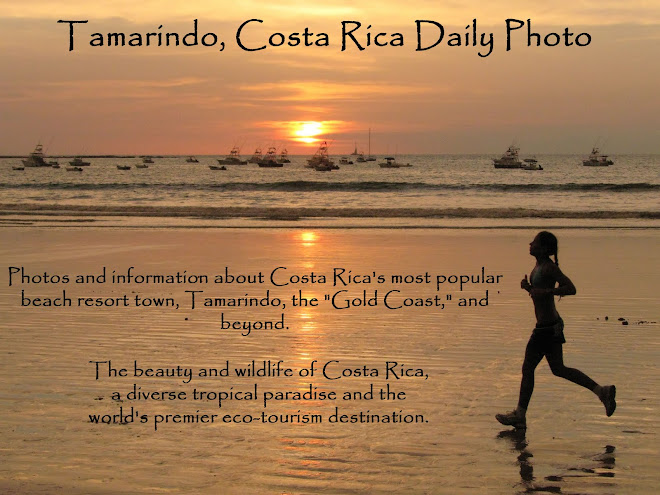
Sunset No. 7, with runner

People love to run along the beach, so why not at sunset? And can there be a better location for running than Tamarindo Beach at sunset? It is broad, gently sloped, not crowded, and the boats in the bay bob up and down with the waves while silhouetted against the crimson sky. Pelicans occasionally dive into the surf for fish.

And for those who are there not to exercise but simply to enjoy the view, well, I am sure that they do not mind having their view of the sunset interrupted by the form of a physically fit runner moving across their field of vision.
Related Posts Plugin for WordPress, Blogger...